How to Stop Bots and Fake Entries in Your Twitch Giveaways
There is no way to stop every bot from entering a Twitch giveaway. What you can do is make it not worth their while, catch most of them before the draw, and make sure a fake entry cannot quietly walk away with the prize. That is the honest goal of this post: fewer bots, a fairer draw, and viewers who trust the result.
Bots come in two kinds, and they need different answers. The first kind enters your giveaway: spam accounts and alt accounts that type the keyword over and over, hoping one of them wins. The second kind targets your viewers: scammers who send fake "you won" messages pretending to be you, asking for a password, a payment, or a link click. This guide covers both, because a giveaway that stops the first kind but ignores the second still harms your community.
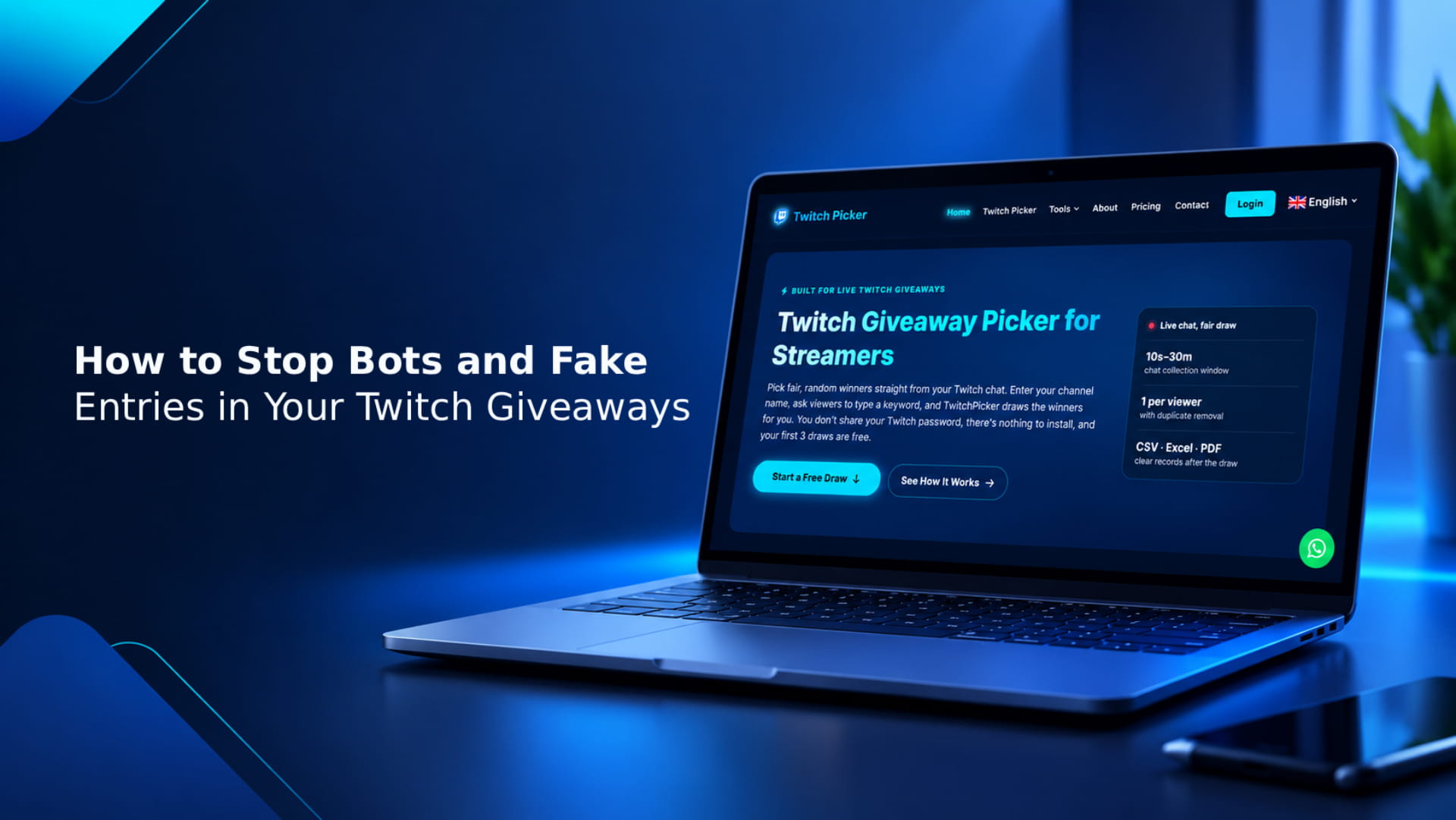
TwitchPicker is the Twitch Giveaway Picker for Streamers. Pick fair, random winners straight from your Twitch chat. Enter your channel name, ask viewers to type a keyword, and TwitchPicker draws the winners for you. You don't share your Twitch password, there's nothing to install, and your first 3 draws are free.
What Bot Entries Actually Look Like
Bot entries rarely announce themselves. They look like ordinary chat messages, one keyword at a time, from accounts you have never seen before. The signs show up in the pattern, not in any single message.
The first sign is the entry count climbing faster than your viewer count. If you have 30 people watching and 120 entries in two minutes, most of those entries are not from your audience. The second is the names: generated-looking usernames, long strings of letters and numbers, or many accounts created in the same week. The third is silence: an account that has never said anything in your chat before, says the keyword once, and then says nothing else. The fourth is repetition: the same message, the same timing, or the same keyword typed by several accounts within seconds of each other. The fifth is the winner: an account with no profile, no chat history, and no followers, drawn from a list full of regulars.
None of these signs proves an account is a bot on its own. A new viewer can have a strange username and say nothing else. A regular can enter the moment you announce the keyword. Treat the signs as a reason to check, not as a reason to accuse someone in public. The checks below are what turn a suspicion into a decision you can stand behind.
Why Bots Target Twitch Giveaways
Bots target giveaways because the maths is in their favour. A prize worth real money, entered by typing one word in chat, costs a bot operator almost nothing to chase. If one operator runs twenty accounts and each has the same chance as a real viewer, that operator has twenty chances to win a prize they can resell, while your real viewers have one each.
The prize matters more than the tool. A small prize — a game key, a small gift card, a free experience — is rarely worth farming, because the effort of running accounts costs more than the prize is worth. A big prize — a console, a graphics card, a large gift card — is worth farming, and it will attract accounts that would never watch your stream otherwise. That does not mean you should never run a big prize. It means a big prize needs more protection than a small one: a shorter entry window, stricter filters, a live draw, and a claim step the winner must complete.
Bots also follow attention. A giveaway announced days in advance, shared widely, or tied to a popular game will draw more fake entries than a spontaneous drop during a normal stream. That is another reason to match the protection to the prize: the more people who hear about the giveaway, the more of them will not be your viewers.
Before Entries Open: Set the Rules That Let You Disqualify Bots
Most bot problems are rules problems. If your rules do not say you can disqualify fake entries, you will have to argue about it live, in front of chat, with the prize on the line. Write the rule first.
Your rules should say, in plain language: one entry per viewer; entries must be typed in chat during the stated window; accounts that look automated, duplicate, or created only to enter may be removed; the winner must claim the prize in chat or by direct message within the stated deadline; and if the winner does not claim it, or turns out to be ineligible, you will draw again from the original entry list. Put that last point in writing, because it is the step that stops a fake win from becoming a lost prize.
The full wording, with every section explained, is in the giveaway rules template, and the reasons behind each rule — including why paid entry can turn a giveaway into a lottery in many places — are in the guide to Twitch giveaway rules. Read both before a big giveaway, and post the finished rules where viewers can read them before entries open. Do not change them once the draw has started.
Use an Unusual Keyword, Not an Obvious One
The keyword is your first filter, and most streamers waste it. If the keyword is !win, !enter, or !giveaway, every bot already knows it, and every viewer who types it by accident enters without meaning to. If the keyword is unusual, tied to your stream, and announced only when entries open, bots have to be watching your stream to know it — and most of them are not.
Pick one short word, in plain letters, that your viewers would not type by accident: a word from your game, an inside joke, a sponsor name, or a word from the prize itself. Say it out loud, put it on your overlay, and repeat it once halfway through the entry window. Do not post it in advance on social media, and do not reuse the same keyword for every giveaway. A keyword that worked last week is a keyword bots have had a week to learn.
This is also why a keyword draw beats a generic command for bot control. A bot can be programmed to type !enter in every stream it finds. It cannot guess a keyword you invented five minutes ago for this stream only.
Turn On the Filters That Actually Help
Filters do not stop bots. They make bot entries harder, and real entries cleaner, and that is enough for most giveaways. TwitchPicker's filters are built for exactly this, and they work best when you set them before entries open and say so in the rules.
One entry per viewer is the most important filter. It stops one account from improving its odds by spamming the keyword, and it stops one operator from winning with the same account ten times. It does not stop twenty accounts, but it stops the cheapest trick first.
A minimum message length helps in a different way. If entries must be longer than the keyword alone — for example, the keyword plus a word, or a short sentence — then a bot that only types the keyword does not count. It also slows down copy-paste spam, because each entry has to be different enough to pass. Keep the requirement small, so real viewers on mobile can still enter easily.
Exclude words lets you remove entries you do not want counted. Use it for the words bots add to their messages, for spam phrases, or for a word you used in a previous giveaway that keeps appearing by habit. Tag-a-friend entry, when it is part of your published rules, adds another small hurdle: the entrant must tag a real account, which is easy for a viewer and awkward for a bot that only types one word.
Set the entry window to match your audience. TwitchPicker listens to your live chat for a window you choose, from 10 seconds up to 2 minutes on the free plan, or up to 24 hours on the Creator and Growth plans. A short window — two to five minutes for a spontaneous drop — gives bots less time to find the giveaway and join it. A longer window suits a bigger prize or a slower chat, but it also gives fake accounts more time to arrive. Announce the closing time, show a countdown if you can, and do not extend the window because someone missed it.
Draw Live, and Make the Winner Claim It on Stream
A live draw is your best defence against a fake winner, because it turns the result into something everyone watched happen. Draw the winner live, read the name out loud, and show the result on stream. If the winner is in chat, they can claim it right there. If they are not, the claim window in your rules decides what happens next.
Ask the winner to claim the prize in chat within a few minutes, or by direct message within the deadline you published — 24 hours is common for a live draw. A real viewer who just entered will usually reply quickly. A farmed account often will not, because nobody is watching it. That claim step filters fake entries after the draw, without you having to prove anything about the account in advance.
Check the winner before you send the prize. Look at the account: when was it created, does it have a profile and any chat history, has it ever spoken in your stream before? One odd detail is not proof of anything. Several together — a brand-new account, no history, no reply to your claim message — are a reason to follow your rules and draw again from the original entry list. Do that on your next stream, say so publicly, and keep the record of both draws.
Do not accuse the winner in public without proof. Saying "this account looks new, so I am checking it against the rules" is fair. Saying "you are a bot" to a real viewer who just won is a fast way to lose a viewer and start an argument you cannot win. Check privately, decide by the rules, and announce the outcome plainly.
The mechanics of a fair draw — why picking by hand is unfair, how duplicates are removed, and how a secure random draw works — are explained in the guide on how to pick a random winner from Twitch chat. Read it before a big giveaway, and keep the winner certificate and the entry export from the draw, so you can show how the winner was chosen if anyone asks.
What TwitchPicker Can and Cannot Do About Bots
Honesty matters here, because overstating what a tool can do is how streamers get caught out. TwitchPicker can collect entries from your live chat, apply the filters you set — keyword entries, exclude words, one entry per viewer, tag-a-friend, minimum message length — draw a random winner with a cryptographically secure draw, and give you a winner certificate and an entry export as a CSV, Excel, or PDF file, along with engagement stats from the draw.
It cannot check an account's age, whether it follows you, or whether it is a real person. It does not verify identity, and it does not know whether twenty accounts belong to one operator. No chat picker can do that from chat messages alone, and any tool that claims it can is overstating its case.
That is why the filters and the claim step matter more than the tool. The picker makes the draw fair and provable. The rules, the keyword, the window, and the winner check are what keep fake entries out. Use the picker for what it is good at, and do the manual checks yourself for the rest. For the full process, from prize to delivery, read the guide on how to do a giveaway on Twitch.
Warn Your Viewers About Fake "You Won" Messages
The second kind of bot does not enter your giveaway. It messages your viewers pretending to be you, and it is the more harmful of the two, because it can cost a viewer their account.
The pattern is always similar. A viewer gets a direct message, a whisper, or a chat message saying they won your giveaway, with a link to click, a code to claim, or a fee to pay. The message uses your name, your logo, or a username that looks like yours with one letter changed. It asks for a password, a payment, a "verification fee", or a login on a site that is not Twitch. It creates urgency: claim now, or the prize goes to someone else.
Tell your viewers, on stream and in your rules, how you will contact a winner — and how you will not. Say it plainly: you will only contact the winner from your own account, in chat or by direct message from that account, and you will never ask for a password, a payment, or a login on another site to claim a prize. Pin that notice in chat during the giveaway, and repeat it when you announce the winner. A viewer who has heard it once is far less likely to click a fake message.
If a viewer reports a fake message, take it seriously. Tell chat what happened, name the fake account if you can do so safely, and report and block it. Do not ask viewers to click the link to check it, and do not share the link yourself. If a viewer clicked it and entered their password, tell them to change their Twitch password from a clean device, turn on two-factor authentication, and check which apps are connected to their Twitch account.
What Not to Do When You Suspect Bots
A few responses to bots make the problem worse. Do not require paid entry as an anti-bot measure: making viewers subscribe or donate to enter can turn a giveaway into a lottery in many places, and it punishes real viewers more than it punishes bots. Do not make entry depend on following for a week or on an account age you cannot check from chat — you will end up enforcing a rule you cannot measure, and arguing about it live. Do not change the rules mid-draw because you suspect bots: if the rules were wrong, fix them for the next giveaway, not this one. And do not run a bigger prize to make up for a bot problem. A bigger prize attracts more bots, not fewer.
If a giveaway is badly farmed — entries far outnumber viewers, the names are clearly generated, and the winner is an account nobody recognises — you can stop it, say so plainly, and run it again with stricter filters and a shorter window. That is better than handing a prize to a fake account and pretending the draw was fair. Your viewers will respect a streamer who stops a broken giveaway more than one who pushes through it.
A Quick Anti-Bot Checklist for Your Next Giveaway
Run through this list before you open entries, and most bot problems will not reach the draw.
- Write the rules first, including one entry per viewer and the right to disqualify fake entries, and post them before entries open.
- Pick an unusual keyword, announce it only when entries open, and do not reuse last week's keyword.
- Turn on one entry per viewer, a minimum message length, and exclude words for spam phrases.
- Set a short entry window that fits your audience, and do not extend it.
- Keep the prize matched to the giveaway: small prizes weekly, big prizes rarely and with more protection.
- Draw live, read the winner out loud, and require the winner to claim it within the deadline in your rules.
- Check the winner's account before you send the prize, and draw again from the original entry list if they do not claim it or turn out to be ineligible.
- Tell viewers how you will contact the winner, and that you will never ask for a password or a payment.
- Save the winner certificate and the entry export, so you can prove how the winner was chosen.
Final Word
You will not stop every bot. You can stop most of them, and you can stop a fake entry from winning, and that is enough. An unusual keyword, one entry per viewer, a short window, a live draw, and a winner who has to claim the prize will filter out the lazy bots and the farmed accounts, while leaving the draw open to every real viewer in your chat.
Start from TwitchPicker, enter your channel name, set your keyword and your filters, and run your next giveaway live from chat. Your first 3 draws are free, and the certificate and export from the draw are the record that proves it was fair.
Frequently Asked Questions
Watch for entries climbing far faster than your viewer count, generated-looking usernames, very recent accounts, and accounts with no chat history. No single sign proves an entry is fake, so check the winner's account before sending the prize.
No tool can stop every bot from typing in chat, but TwitchPicker makes it harder. Filters like one entry per viewer, exclude words, a minimum length, and an unusual keyword block the cheapest tricks, and the live draw proves how the winner was chosen.
No, not as your main defence, because you cannot reliably check follow age or account age from chat alone. Keep entry free, use filters and a claim step instead, and remember paid entry can turn a giveaway into a lottery in many places.
Do not send the prize yet, and check the winner against the rules you published. If the winner does not claim it in time, or turns out to be ineligible, draw again from the original entry list on your next stream and say so.
Tell viewers you will only contact the winner from your own account, never asking for a password, payment, or login elsewhere. Pin that notice in chat, repeat it when you announce the winner, and report and block any fake account reported.