Twitch Giveaway Rules: What Streamers Need to Know
Yes, giveaways are allowed on Twitch. Twitch's Terms of Service include a Promotions clause that permits contests and sweepstakes, as long as they comply with the law. The part most streamers miss is who carries the responsibility: Twitch classifies you, the streamer, as the sole promoter. That means the rules, the draw, the prizes and the legal compliance are all yours — Twitch provides the stage, not the safety net.
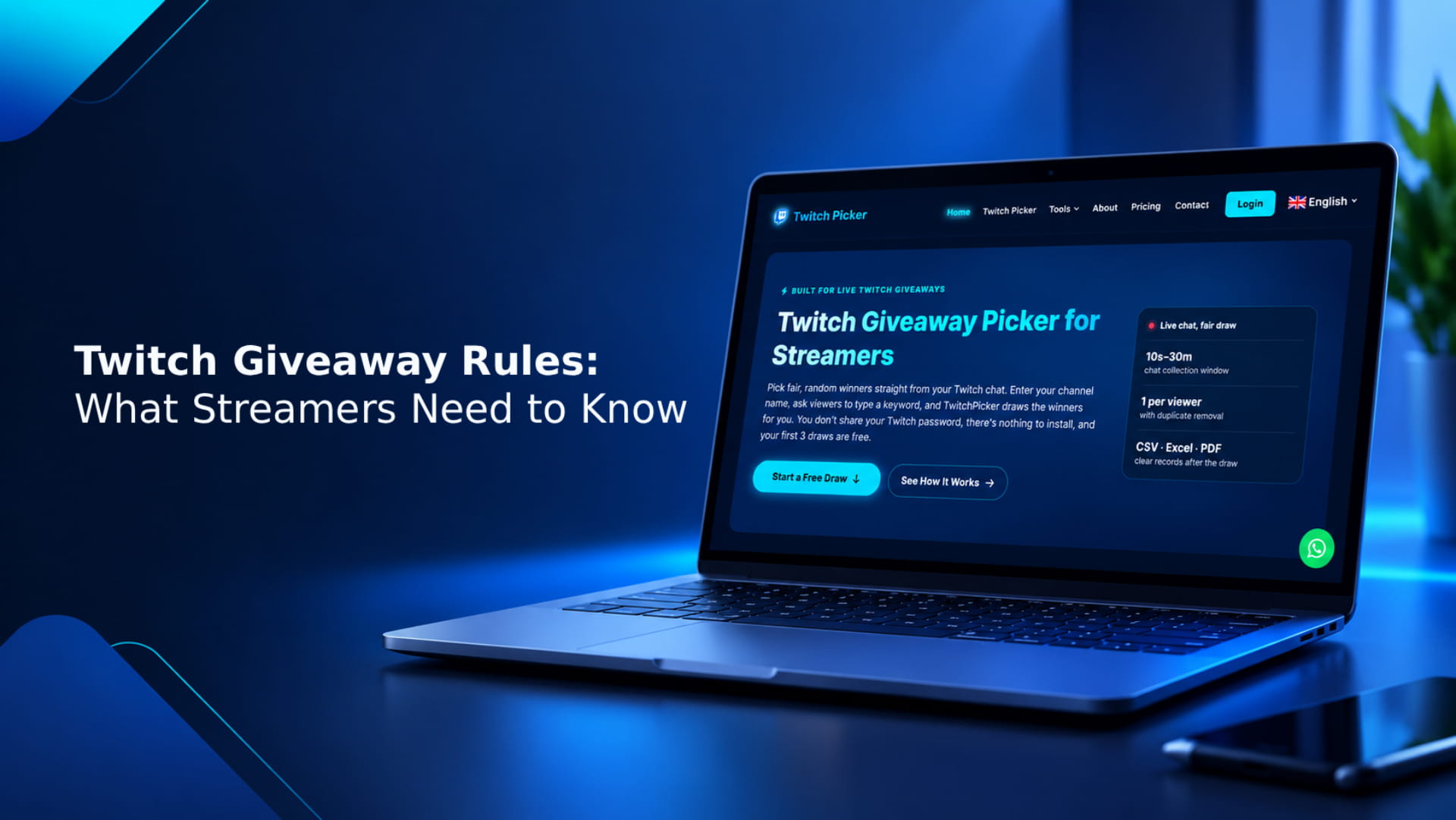
TwitchPicker is the Twitch Giveaway Picker for Streamers. Pick fair, random winners straight from your Twitch chat. Enter your channel name, ask viewers to type a keyword, and TwitchPicker draws the winners for you. You don't share your Twitch password, there's nothing to install, and your first 3 draws are free. The tool handles the draw; this guide handles the rules around it, so the giveaway holds up if anyone asks questions afterwards.
This post is general information, not legal advice. TwitchPicker is not affiliated with Twitch. For anything beyond the basics here — a large prize, a sponsored giveaway, or viewers in many countries — check Twitch's own Terms of Service and Community Guidelines, and get qualified advice before you go live.
What Twitch's Own Rules Actually Say
Twitch does not publish a separate set of contest rules for streamers to follow. What it has is the Promotions clause in its Terms of Service, and that clause is short, specific, and worth reading before you run anything.
First, you are the promoter. Twitch's terms say you will be classified as the promoter of your promotion in the applicable jurisdiction, and you are responsible for the execution, administration and operation of the promotion, drafting and posting the official rules, selecting winners, issuing prizes, and filing any necessary registrations and bonds. If something goes wrong — a winner never gets the prize, a viewer complains the draw was rigged — that complaint lands on you, not on Twitch.
Second, you must show a specific disclaimer. Twitch requires you to display or read out the following when promoting, administering or conducting a promotion: "This is a promotion by [Your Name]. Twitch does not sponsor or endorse this promotion and is not responsible for it." Put your channel name in the brackets, say it on stream, and keep it visible in your stream description or pinned chat message while entries are open. It costs you one line and it is the single most concrete thing Twitch asks of you.
Third, never imply Twitch sponsors or co-sponsors your giveaway. Do not put a Twitch logo on the prize graphic, do not say "Twitch is giving this away," and do not suggest the platform picked the winner. The disclaimer exists precisely because viewers assume the platform is behind anything that happens on it.
Fourth, Twitch can remove a promotion it reasonably believes does not comply with its terms or the law. That is the enforcement mechanism: there is no Twitch giveaway police checking your rules in advance, but a reported promotion can be taken down, and a streamer who repeatedly runs non-compliant promotions risks action on their channel.
Finally, the rest of Twitch's rules still apply. A giveaway cannot be used to drive fake engagement, inflate view counts, or hand out a prohibited prize — a giveaway for an age-restricted or banned item breaks the Community Guidelines just as surely as streaming that item would. The rules in this post sit on top of the Community Guidelines, not instead of them.
The Lottery Test: Prize, Chance and Consideration
Most giveaway law in the US, the UK and the EU comes down to one test with three parts. A promotion becomes an illegal lottery when all three are present at once: a prize, chance, and consideration. A prize is anything of value. Chance means the winner is picked at random rather than by skill. Consideration means the entrant had to give something of value to enter — usually money, but it can also be a purchase or a paid subscription.
A normal Twitch giveaway has the first two by design: there is a prize, and the winner is drawn at random. So the whole question turns on the third part. Keep entry free and you are running a sweepstakes, which is legal in most places with the right rules. Charge for entry and you may be running a lottery, which needs a licence almost nobody has.
Free entry is therefore the foundation of every rule in this guide. State it plainly in your official rules: "No purchase necessary. Free to enter." If you run the entry through a keyword in chat, that is already free — typing a word in chat costs a viewer nothing. If you also collect entries somewhere else, such as a form, keep that route free too, and make sure the free route is genuinely equal: the same prize, the same odds, the same deadline. A free route buried where nobody can find it does not protect you.
The alternate method of entry, often shortened to AMOE, is the formal version of this idea. If any part of your giveaway involves paying — a subscriber-only draw, a Bits donation, a paid raffle ticket — the AMOE is the free path in, usually a form or an email entry, open for the same window and for the same prize. Without it, the paid part is the whole story, and the whole story is a lottery. With it, the giveaway stays a sweepstakes. When in doubt, the safest design is the simplest one: everyone enters free, through the same keyword, in the same window.
Subscriber-Only Giveaways and Paid Entry
Subscriber-only giveaways are the most common way Twitch streamers accidentally cross the line. Twitch itself does not separately ban subscriber-only giveaways — the constraint comes from the law, not from a special Twitch rule. The problem is consideration: a subscription costs money, so a draw that only subscribers can enter is a draw where entrants paid for their chance to win. In many US states and in several other countries, that is a lottery.
That does not mean subscribers can never get anything extra. It means the prize draw itself should be open to everyone for free, and subscriber perks should stay separate from it. Run the giveaway as a free keyword entry for the whole chat, and give subscribers something that is not a prize draw — a subscriber-only stream, an emote, a shout-out, a game night. The perk is the reward for subscribing; the giveaway is the event everyone can enter.
The same logic applies to Bits and Channel Points. Bits cost real money, so requiring a Bits donation to enter is paid entry. Channel Points are earned by watching, not bought, so they sit in a greyer area — but a giveaway that requires viewers to spend points they could only earn by watching for hours is still a barrier, and some regulators treat anything of value, including time-locked currency, as consideration. Do not build your entry method on either. A keyword in chat, open to everyone, is free in every sense that matters, and it is also the entry method a chat picker is built for: one entry per viewer, keyword entries, and a draw from the live chat.
If a sponsor or a community member suggests a "sub-only" draw, say no to the draw and yes to the sentiment. Offer the sponsor a free-entry giveaway with a subscriber shout-out segment, or run a separate, non-prize subscriber appreciation stream. The audience that matters will understand, and the one viewer who knows the law will not have anything to report.
Who Can Enter: Age, Countries and Your Own Team
Your official rules need to say who can enter, and three groups deserve a decision before you go live.
Age first. A Twitch account requires the user to be at least 13 years old, or the minimum age where they live if that is older — 16 in Australia — and users between 13 and the age of majority use Twitch under a parent or guardian's supervision. That is the account rule, not the giveaway rule. For the giveaway itself, you set the minimum age in your rules, and many streamers set 18+ for prizes, especially for physical prizes that need a shipping address, or for prizes with their own age limits such as games rated 18+. Whatever you choose, state it in the rules and stick to it. Drawing a winner and then discovering they are too young to receive the prize is a problem you created by not writing the line down.
Countries second. A physical prize can only go where you can legally and affordably ship it, and some countries restrict or ban prize promotions entirely. Digital prizes — game keys, gift cards, subscriptions — travel further, but gift cards are often region-locked and some game keys will not activate outside their region. List the eligible countries in your rules, and keep the list honest: "open worldwide" is only true if you can actually deliver the prize worldwide. If you are unsure, restrict the giveaway to the countries you know you can serve, and say so plainly. For the full walkthrough of setting up a giveaway, including the entry keyword and the live draw, read our guide on how to do a giveaway on Twitch.
Your own team third. Exclude yourself, your mods and anyone who helped run the giveaway from entering. It is not a legal requirement in most places, but it is the cheapest trust you will ever buy: nobody can claim the draw was fixed for a mod if mods were never in the pool. Write the exclusion into the rules so it is a fact, not a favour.
What Your Official Rules Must Cover
Twitch's Promotions clause requires official rules, and the rules are where everything in this post becomes enforceable. They do not need to be long — a short, specific set of rules beats a wall of legal text that nobody reads — but they do need to answer the questions chat will ask: what the prize is, who can enter, how to enter and when entries close, how the winner is picked, when the winner must claim the prize, and the Twitch disclaimer.
We have a separate, practical guide to writing those rules, with a fill-in-the-blank example you can copy into your stream description or Discord: read how to write giveaway rules. That post is the how-to; this post is the why — the Twitch clause and the lottery test that make each of those lines necessary. Use them together: this post tells you what the rules must achieve, that post tells you how to write them.
Two habits make the rules hold up. First, post them before entries open, and do not change them once the draw has started — even a small change at that point looks like you are steering the result. Second, keep a record: the exported entry list, the draw result and the winner certificate. TwitchPicker's live chat capture runs from 10 seconds up to 2 minutes on the free plan, or up to 24 hours on the Creator and Growth plans, draws multiple winners in one draw from the same pool, and exports the result as CSV, Excel or PDF on the Creator and Growth plans, so the record exists without extra work. If a viewer questions a draw from three months ago, the export is your answer.
If writing the rules from scratch feels like work, use the giveaway rules generator to build a clean version from a short form, then read it once and adjust anything that does not match your giveaway. A generated draft you have read is far better than a copied template you have not.
Sponsored Giveaways: Disclosure Comes First
A sponsored giveaway adds a second layer of rules on top of everything above, and the brand paying for the prize does not move any responsibility off you. Under Twitch's terms you are still the promoter. Under advertising law you are still the one who must disclose.
In the US, the FTC's Endorsement Guides require a clear disclosure whenever a brand has paid you or given you a free product — early in the stream, in plain language, and in a form viewers cannot miss. A brand hashtag alone is not enough, and a disclosure buried in your channel panels does not count. Say it out loud when the giveaway starts, put "#ad" or "paid partnership" where viewers will see it, and use Twitch's branded content disclosure tool when it applies. The same principle holds in the UK under the CAP Code and in the EU: the commercial relationship must be obvious before a viewer decides to enter.
Agree the terms with the sponsor before you announce anything: who writes the official rules, who picks the winner, who ships the prize, and what happens if the winner does not claim it. Put the sponsor's name in the rules, and keep the draw itself exactly as you would run it unsponsored — a free keyword entry, a random draw, a public announcement. A sponsor who asks you to pick a specific winner, or to exclude part of your audience, is asking you to run a rigged draw. Say no, even if the prize is generous.
After the draw, the sponsor will want numbers. Entry counts, peak viewers during the entry window, and the winner announcement are the honest report — and the export from your draw gives you all three without guessing. Engagement stats from the draw are the same numbers you would show a sponsor for any other stream segment, so treat them that way: real figures, from the real draw, shared once.
Running a Giveaway for Viewers in Other Countries
If your viewers live in more than one country, your giveaway lives under more than one set of rules. You do not need to become an expert in every country's law, but you do need to know where the sharp edges are.
In the US, the federal picture is the lottery test above, and the state picture adds registration. New York and Florida require registration and bonding for sweepstakes with prizes over $5,000, and several other states have their own filing rules for large prizes. That is one more reason to keep prize values modest and to state the approximate retail value in your rules: a $50 game key and a $5,000 prize are different legal events, and the rules should reflect that.
In the UK, promotions fall under section 8 of the CAP Code, which requires the terms to be clear and the draw to be conducted fairly, and under the Gambling Act, where a prize draw must be genuinely free to enter to avoid being classed as a lottery. In the EU, the GDPR matters the moment you collect personal data: only collect what you need to deliver the prize — usually a name and a delivery address or email — say why you are collecting it, and delete it once the prize is delivered. Do not keep a spreadsheet of viewer addresses after the giveaway ends.
Tax is the part streamers forget. In most countries the winner is responsible for tax on the prize, and in the US prizes over $600 are commonly reported to the tax authorities. Say in your rules that the winner is responsible for any taxes, and for a large prize, ask the winner for the details you need to report it. That line costs you nothing and saves an argument later.
When in doubt, narrow the map. A giveaway open to viewers in your own country, with a digital prize and a free keyword entry, is simple to run and simple to defend. A worldwide giveaway with a physical prize, paid entry and no written rules is the opposite. The size of the audience is not the measure of a good giveaway; the size of the problems it creates is.
What Happens If You Get It Wrong
The consequences of a bad giveaway are usually practical before they are legal. The most common outcome is the one Twitch's terms describe: the promotion gets removed. A viewer reports it, Twitch reviews it, and the giveaway disappears from your channel. That is embarrassing, and it is also the mildest outcome.
The next level is the dispute. A viewer who believes the draw was unfair will say so in chat, in your Discord, and on social media, and a dispute with no written rules and no draw record is very hard to win. That is why the record matters: a random draw from a cleaned entry list, with the result exported and the winner announced publicly, is a defence you can show in one link. For how the draw itself should run, including one entry per viewer, keyword entries, exclude words and a minimum message length, read our guide on how to pick a giveaway winner.
The serious level is the legal one, and it usually arrives through the paid-entry door: a sub-only draw, a Bits-gated entry, or a prize promotion run in a country that requires registration you never filed. Fines and enforcement are rare for small streamers, but they are real, and they fall on the promoter — on you. The same applies to a sponsored giveaway with no disclosure: the regulator's complaint goes to the streamer who failed to disclose, not only to the brand.
None of this is a reason to stop running giveaways. It is a reason to run them the boring way: free entry, written rules, a fair random draw with a record, and the disclaimer Twitch asks for. A giveaway run that way is hard to complain about, easy to defend, and more fun for everyone watching — which is the point of running one in the first place.
A Pre-Stream Rules Checklist
Run through this list before you open entries. It takes five minutes and it catches almost every mistake in this post.
- Prize named exactly, with its approximate value, and checked as something you can legally give away and actually deliver.
- Eligible countries listed, and a minimum age stated in the rules.
- Entry method is free for everyone — a keyword in chat, one entry per viewer, no purchase, no subscription and no Bits required.
- Entry window written down with a start and end time, including the time zone.
- Official rules posted before entries open — in your stream description, a pinned chat message, or Discord — and not changed afterwards.
- The Twitch disclaimer displayed or read out: "This is a promotion by [Your Name]. Twitch does not sponsor or endorse this promotion and is not responsible for it."
- Sponsored? Disclosure said out loud and marked "#ad" or "paid partnership" before entries open.
- The draw planned as a live, random draw from the entry list, with the result exported and the winner announced on stream.
If any item on the list is not true yet, fix it before you open entries. A giveaway that starts with all eight in place is a giveaway you can enjoy running, and a giveaway your viewers can trust.
Final Word
Twitch giveaway rules are not a wall of legal text. They are four habits: free entry for everyone, written rules posted before entries open, a fair random draw you can show, and the disclaimer Twitch requires. Twitch's Promotions clause gives you permission to run giveaways and makes you responsible for them in the same breath — read it once, build the habits around it, and the rest is just running a good stream.
Start from the TwitchPicker homepage, where you paste your channel name and run the draw. Your first 3 draws are free, with no card, and Creator is $5 a month and Growth is $50 a year, both with unlimited draws and identical features. The draw is the easy part. The rules are what make it fair — and now you know what they are.
Frequently Asked Questions
Yes, Twitch's Terms of Service allow contests and sweepstakes, and the Promotions clause makes you the sole promoter. You are responsible for the official rules, the draw, the prizes and following the law where you run it.
Yes, Twitch's Promotions clause requires official rules, and written rules are what protect you when a viewer disputes a winner. Keep them short, post them before entries open, and do not change them once the draw has started.
A giveaway that only subscribers can enter is risky, because paying to enter can turn a sweepstakes into an illegal lottery in many places. Offer a free entry route for everyone, and keep subscriber perks separate from the prize draw.
Twitch requires you to display or read out: "This is a promotion by [Your Name]. Twitch does not sponsor or endorse this promotion and is not responsible for it." Never suggest Twitch sponsors your giveaway, and keep the disclaimer visible while you promote it.
Twitch can remove a promotion it believes breaks its Terms of Service or the law, and a disputed draw can cost you viewers and sponsors. The fix is boring but reliable: free entry, written rules, a fair random draw and the required disclaimer.